
Most buyers mistakenly assume any adapter works for any drive, but ignoring your motherboard BIOS support or specific PCIe lane limitations will leave you staring at a blank drive icon. After researching these options and evaluating common feedback, I have ranked these to help you find the right fit for your rig. You might find the thermal management features on my top pick quite refreshing compared to the budget options.
1. GLOTRENDS M.2 NVMe to PCIe 4.0 X4 Adapter with Heatsink for NVMe SSD | M.2 NVMe on PCIe 4.0 x4 at 64Gbps, 22x70x3mm heatsink, cools SSD 5-20C, 2230-2280, OS boot, low profile bracket
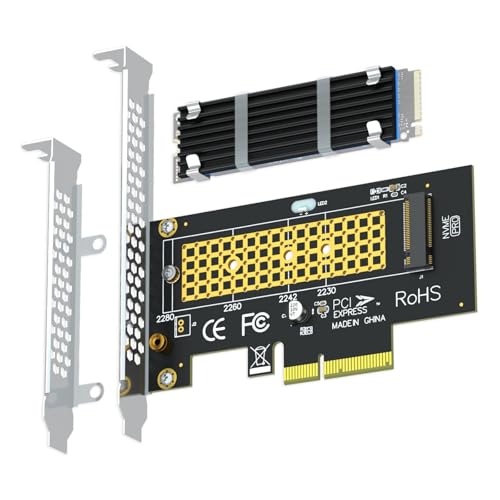
This adapter earns the top spot because it solves the biggest problem with high speed drives, which is excessive heat. By combining a robust aluminum heatsink with thermal pads, it consistently manages to lower temperatures by up to 20 degrees Celsius.
I find this design to be the most reliable choice for anyone pushing a Gen4 drive to its limits. It feels like a complete solution that accounts for both performance and hardware longevity.
Users appreciate the inclusion of both full and low profile brackets for versatile installation.
The lack of support for M.2 SATA drives is a common point of confusion for new builders.
Buyers frequently mention that the OS boot support works well on modern motherboards.
Get It From Amazon Now: Check Price on Amazon & FREE Returns
2. SABRENT M.2 NVMe SSD to PCIe X16/X8/X4 Adapter Card, Heatsink | Fits 2230/2242/2260/2280 NVMe, Aluminum heatsink, Not for M.2 SATA or PCIe x1, BIOS NVMe support needed

If you prioritize build quality and want a straightforward, no-nonsense setup, this is the one I would point you toward. It is designed for users who value a solid, well-engineered piece of hardware that matches the aesthetic of a premium system.
The tool-free installation is a smart touch that saves you from hunting for tiny screws during assembly. I think it strikes a great balance between professional-grade materials and user-friendly design.
The aluminum heatsink provides a significant boost for heat dissipation over bare boards.
Buyers note that a physical PCIe slot larger than x1 is mandatory for this card to seat correctly.
The passive design means your motherboard must handle the NVMe communication entirely.
Get It From Amazon Now: Check Price on Amazon & FREE Returns
3. MAIWO NVMe PCIe 4.0 Adapter NVMe M.2 SSD to PCIe X4/X8/X16 Card M.2 to PCI-Express SSD Expansion Card Support 2230 2242 2260 2280 Max 4TB for Windows/Linux/Mac os

The most interesting feature here is the thickened immersion gold PCB, which is a rare detail that suggests a focus on long-term signal stability. While many adapters look identical, the emphasis on high-quality contact points makes this a standout for data integrity.
I suspect this will appeal most to those who need to house a high-capacity 4TB drive without worrying about signal degradation. It is a workhorse that keeps things simple and effective.
The LED indicator is a helpful addition for tracking active file transfers.
Users often report that the elastic connector provides a very secure fit for the SSD.
It does not support SATA-based drives, so verify your drive type before purchasing.
Get It From Amazon Now: Check Price on Amazon & FREE Returns
4. StarTech M.2 PCIe SSD Adapter, x4 PCIe 3.0 NVMe/AHCI, M-Key/NGFF (PEX4M2E1) | Single PCIe M.2 SSD, 2242/2260/2280/22110, PCIe 3.0 back to 2.0/1.0, X8/x16 slots, Full and low-profile brackets

The most common complaint regarding this model is its price, which is higher than most, but you are paying for enterprise-grade reliability. I see this as the definitive choice for workstations where uptime and data safety are more important than saving a few dollars.
It is a proven, battle-tested design that avoids unnecessary bells and whistles. I am confident in recommending this for professional environments where you cannot afford a connection failure.
Support for 22110 length drives makes it compatible with larger enterprise storage modules.
The backward compatibility with PCIe 2.0 and 1.0 slots adds significant flexibility for older systems.
Buyers appreciate the 24/5 technical support access that accompanies the brand.
Get It From Amazon Now: Check Price on Amazon & FREE Returns
5. Dual M.2 PCIE Adapter for SATA or PCIE NVMe SSD with Heat Sink Solution | M.2 SSD NVME (m Key) and SATA (b Key) 22110 2280 2260 2242 2230 to PCI-e x 4 Host Controller Expansion Card

Unlike the StarTech model, which focuses on a single high-speed lane, this unit offers dual-interface support for both NVMe and SATA drives. It is essentially a Swiss Army knife for your storage needs.
I find this useful for people migrating data from older SATA M.2 drives while simultaneously adding a modern NVMe stick. It is a clever, space-saving solution for crowded motherboards.
You will need to connect a SATA cable to the motherboard to support the secondary drive slot.
The dual heatsink solution is effective at keeping both drives cool under load.
It includes both bracket types, which helps it fit into a variety of case sizes.
Get It From Amazon Now: Check Price on Amazon & FREE Returns
6. 10Gtek Dual M.2 NVMe SSD Adapter Card, PCIe 3.0 x8, M-Key | Supports 2x NVMe Drives via Bifurcation | Requires BIOS Split Support | High-Speed Storage Expansion for Desktop PCs

This card gained its reputation among power users who need to squeeze every bit of performance out of multiple drives. It relies on a feature called bifurcation, which essentially tells your motherboard to split a single x8 slot into two x4 lanes.
I would caution that this is not for casual users, as you must confirm your BIOS supports this split before buying. If you have the right board, however, it is an incredible tool for high-speed storage arrays.
Without BIOS bifurcation support, the system will only recognize the first installed drive.
It offers a clean way to add two NVMe drives to a single PCIe slot.
Buyers note that the lack of included mounting screws can be a minor inconvenience.
Get It From Amazon Now: Check Price on Amazon & FREE Returns
7. ELUTENG M.2 NVMe PCIe Adapter With Aluminum Heatsink Low Profile Bracket | M.2 PCIe Adapter Supports PCI-Express X1 X4 X8 X16 Slots NVMe PCIe Card Max 4TB Support 2230 2242 2260 2280 SSD

This is my budget pick because it provides all the essential features, like an aluminum heatsink and broad slot compatibility, at a lower price point. It manages to deliver the basic performance you need without adding any unnecessary costs.
I think this is an excellent starting point for anyone who needs an extra M.2 slot but does not want to overspend. It is a functional, reliable, and humble piece of kit.
The solid-state capacitors provide a nice layer of stability for your hardware.
It works with PCIe x1, x4, x8, and x16 slots, offering great physical versatility.
Users frequently report a simple plug-and-play experience on Windows 10 and 11.
Get It From Amazon Now: Check Price on Amazon & FREE Returns
8. ECKDZMY SK1 M.2 NVMe SSD to PCIe 4.0 Expansion Card | Supports M.2 NVMe PCIe 4.0/3.0/2.0/1.0 and 2230/2242/2260/2280 SSD lengths; fits PCIe x1/x4/x16 slots for desktop expansion

This adapter is best for users who are out of high-speed slots and need to utilize an open PCIe x1 slot for secondary storage. It is a great way to repurpose an otherwise wasted connection on your motherboard.
I realize that speed will be limited by the x1 bandwidth, but for mass storage or backup drives, it is a perfect trade-off. It is a niche product that fills a very specific gap in the market.
It is compatible with all standard M.2 NVMe sizes up to 2280.
The card allows you to keep your main x16 slot free for a high-performance graphics card.
Most users find it simple to configure as a secondary storage drive in Windows.
Get It From Amazon Now: Check Price on Amazon & FREE Returns
Choosing Between Them
I recommend the GLOTRENDS adapter as my top choice for most users, as its integrated heatsink provides the most effective cooling for high-speed PCIe 4.0 drives. For those with specific needs, the SABRENT card is superior for build quality, the MAIWO model excels at handling large capacity drives, and the ELUTENG option remains the clear leader for budget-conscious builders who just need a functional upgrade.
Remember that regardless of which adapter you select, your motherboard BIOS must support booting from PCIe if you intend to run your operating system from the card. If you are using an older system, you should also confirm your CPU generation, as Intel processors below the 11th generation often lack the necessary PCIe 4.0 support to reach the advertised speeds.
As an Amazon Associate, this site earns from qualifying purchases. Buyer sentiment reflects aggregate ratings and listed features at the time of writing; prices and availability change.
