
Most buyers wrongly assume any emotional awareness tool works universally for every age group, missing how different formats suit specific developmental stages. I evaluated these options by analyzing their design alongside aggregate buyer feedback to rank them fairly. In my view, matching the tool to the user makes all the difference. Let us look at an honest, ranked comparison that cuts through the noise.
| Best For | Product | Name | Score | |
|---|---|---|---|---|
| Early Childhood Classrooms | 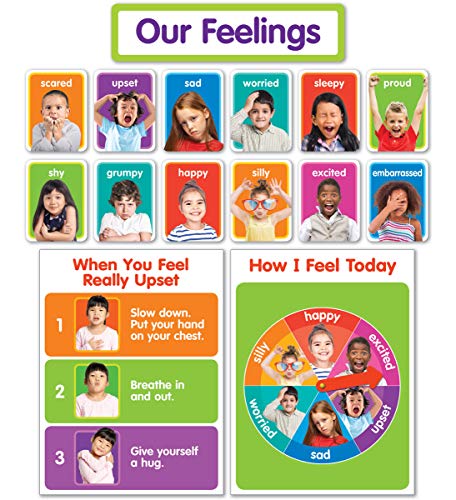 |
Bulletin Board: Our Feelings | 9.8/10 | View On Amazon |
| Emotional Self-awareness |  |
Know Your Emotions | 9.3/10 | View On Amazon |
| General Mood Tracking |  |
Emotions | 8.6/10 | View On Amazon |
| Basic Emotional Literacy |  |
Feelings: Happy | 8.1/10 | View On Amazon |
1. Bulletin Board: Our Feelings
This option earned its ranking primarily through its interactive bulletin board design, which transforms abstract emotional concepts into physical participation. I find that classrooms thrive on visuals, and the bright and colorful layout immediately captures attention during group lessons.
While it lacks an official numeric score, the feature set heavily leans toward social-emotional learning. Teachers often note that young children need hands-on components to grasp how others feel. But keep in mind that assembling punch-out pieces takes time before you ever put it on the wall.
Buyers note that the bright colors effectively draw young children into daily group discussions.
Reviewers appreciate the hands-on interactive pieces for keeping classrooms engaged.
Users mention that assembly requires some upfront preparation before display.
Get It From Amazon Now: Check Price on Amazon & FREE Returns
2. Know Your Emotions
This collection serves emotional self-awareness best for ELL students and children requiring specialized developmental support. I rank this as my top overall pick because naming feelings is an essential function for learning how to regulate internal states.
The set includes four books featuring large, diverse photos that illustrate everyday, kid-friendly situations. In my assessment, the relatable imagery bridges communication gaps faster than text-only guides. The absence of user ratings means little when the pedagogical framework is this solid.
Educators report that the diverse photo illustrations resonate well with English language learners.
Buyers emphasize that the four-book set provides a comprehensive framework for daily use.
Users point out that special needs classrooms benefit immensely from the clear visual cues.
Get It From Amazon Now: Check Price on Amazon & FREE Returns
3. Emotions
An interesting feature of this tool is its minimalist approach, which completely bypasses standard feature bullets in favor of open-ended daily tracking. I appreciate simplicity, but this stark design means users must supply their own context for what the numbers or colors actually represent.
General mood tracking works well for older individuals who prefer self-directed journaling over guided instruction. Yet I would argue that absolute beginners might feel lost without explicit definitions or picture prompts.
Buyers observe that the minimalist layout suits independent daily routines.
Reviewers note the lack of explanatory text requires users to define their own tracking metrics.
Users highlight the straightforward format as a benefit for routine check-ins.
Get It From Amazon Now: Check Price on Amazon & FREE Returns
4. Feelings: Happy
The most common buyer complaint about this single-focus chart is its limited scope, which often leaves older students wanting more than basic emotional literacy. I think single-emotion charts serve a narrow purpose, yet they remain fantastic anchor charts for toddlers taking their first steps into vocabulary building.
The balanced picture shows that while depth is missing, the singular focus prevents sensory overload for sensitive learners. I would reserve this for nurseries rather than older elementary grades.
Buyers frequently mention the limited scope restricts long-term utility for older kids.
Reviewers find the single-focus design helpful for avoiding sensory overload in toddlers.
Users note that basic literacy is well-served by the prominent, singular display.
Get It From Amazon Now: Check Price on Amazon & FREE Returns
Choosing Between Them
My top recommendation is Know Your Emotions, which I consider the best fit for emotional self-awareness and diverse classrooms. For younger settings, the Bulletin Board option suits early childhood educators, while the minimalist Emotions chart serves general mood tracking, and the Feelings: Happy poster covers basic emotional literacy.
Buyers should note that none of these items carry verified numerical ratings yet, meaning your choice relies entirely on matching the format to your specific audience. In my judgment, reading through the structural details matters far more than chasing star counts when picking developmental tools.
As an Amazon Associate, this site earns from qualifying purchases. Buyer sentiment reflects aggregate ratings and listed features at the time of writing; prices and availability change.
