
Ever opened a message and saw “HML” just sitting there… and you paused, slightly confused? Yeah, that happens more often than people admit. The phrase HML meaning in text has quietly become part of everyday digital communication, yet many still don’t fully get it.
Here’s the simple truth right upfront: HML → stands for → Hit My Line. That means someone is asking you to call or text them. Sounds easy, right? But hold on, there’s more nuance here than you’d expect. The tone, context, and platform all shape how it feels. Let’s break it all down properly so you never misread it again.
What Does HML Mean in Text?
HML means “Hit My Line,” which is a casual way of asking someone to contact you, usually via phone or message. It’s informal, relaxed, and commonly used in personal chats.
In simple terms, when someone says HML, they’re saying:
- Reach out to me
- Call me when you can
- Text me later
This is part of modern texting slang, where shorter phrases replace longer sentences. And honestly, people just prefer typing less these days, it feels quicker and more natural.
HML → used for → requesting communication (call or text). That’s the core function, and it rarely changes.
Origin of HML: Where Did It Come From?
The phrase didn’t just appear out of nowhere. It evolved through layers of cultural and technological shifts.
Texting abbreviations → emerged from → SMS character limits. Back in early SMS culture, messages had strict limits, so people shortened everything. That’s how abbreviations like LOL, BRB, and eventually HML came into play.
At the same time, HML → originated from → urban slang and hip-hop culture. Artists often used “hit my line” in lyrics, meaning “contact me” or “reach out.” Over time, social platforms like Instagram and Twitter helped spread it fast.
Today, Gen Z and Millennials use it casually across online messaging apps, and it’s become a staple in internet slang meanings.
How HML Is Used in Real Conversations

You’ll mostly see HML in informal chats. The tone depends heavily on context, and sometimes it even carries emotional weight.
Here are common situations where people use it:
- Making Plans
“Going out later, HML if you’re free.”
This means they’re inviting you to connect and join. - Reconnecting
“Long time no talk, HML.”
Feels friendly, almost nostalgic. - Offering Help
“If you need help, HML anytime.”
Shows openness and availability. - Flirting
“Can’t sleep… HML.”
Yeah, this one usually carries a subtle hint. - Networking (Casual)
“Let’s collaborate, HML.”
Often seen in social media platforms like Instagram DMs.
You see the pattern? It always revolves around communication, but the vibe shifts depending on the situation.
Emotional Meaning Behind HML (It’s More Than Just Words)
At surface level, it’s just slang. But underneath, there’s something deeper going on.
HML → signals → openness and connection.
When someone says HML, they’re not just giving instructions. They’re inviting interaction. It can quietly mean:
- I want to talk
- I’m thinking about you
- I’m available
- I miss our conversations
And honestly, in today’s fast-paced world, short phrases like this reduce pressure. Saying “HML” feels lighter than writing a full sentence. That’s why informal communication style dominates modern chats.
HML vs Similar Slang Terms (Quick Comparison)
People often confuse HML with other texting abbreviations list entries. Let’s clear that up.
| Term | Meaning | Key Difference |
|---|---|---|
| HML | Hit My Line | Focused on calling/texting |
| HMU | Hit Me Up | Broader, more casual |
| DM Me | Direct message me | Platform-specific |
| Ping Me | Notify me | Slightly professional |
HMU vs HML difference is subtle but real. HMU feels more general, while HML leans toward direct contact via phone or personal messaging.
When HML Means Something Else (Important Context)
Here’s where things get interesting. Context changes everything.
Context → determines → meaning of HML (positive or negative).
In rare cases, HML can also mean “Hate My Life.” That’s a completely different tone.
Example:
“Failed my exam… HML.”
Now it’s negative, expressing frustration or disappointment. This is why understanding context-based meaning in texting is crucial.
Don’t assume blindly. Always read the full message.
Examples of HML in Sentences
To make things crystal clear, here are real-life examples:
“I’ll be home soon, HML.”
“Need gym advice? HML.”
“Coming to your city next week, HML.”
“Got something important, HML ASAP.”
“If you’re awake, HML.”
“Miss talking to you… HML sometime.”
Each one shows how natural it fits into online conversation phrases. It’s quick, flexible, and easy to use.
Why Understanding HML Meaning in Text Matters Today
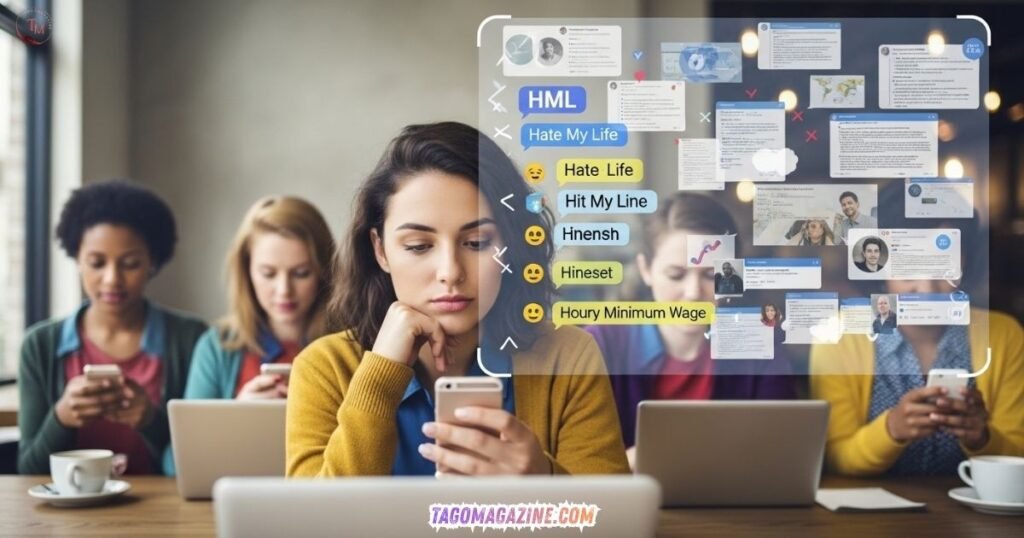
You might think it’s just slang, not a big deal. But it actually plays a role in communication quality.
If you misunderstand it:
- You might misread tone
- You could respond awkwardly
- You may seem out of touch
In branding and content creation, knowing modern slang terms helps you connect with your audience. In friendships or dating, it avoids confusion.
And honestly, language is evolving faster than ever. Staying updated with Gen Z texting slang keeps you socially fluent.
Psychological Reason Behind Using HML (Topical Gap Explained)
Let’s go deeper, because competitors barely touched this.
People use short slang like HML due to cognitive ease. It reduces effort in both writing and reading. The brain processes shorter phrases faster, which makes communication feel smoother.
There’s also a social factor. Using casual texting language creates a sense of belonging. If you understand and use the same slang, you feel part of the group.
So, internet slang meanings → improve → social bonding in digital spaces. It’s subtle, but powerful.
Platform-Specific Usage of HML (Topical Gap Explained)
Not all platforms use HML the same way. This part is often ignored, but it matters.
On Instagram and Snapchat, HML is casual and often flirty. It appears in stories, captions, or DMs.
On Twitter (X), it’s more public. People might use it for networking or announcements.
On messaging apps like WhatsApp, it’s more personal and direct.
In professional platforms, though, it’s rarely used. Instead, phrases like “reach out to me” or “contact me” replace it.
So yeah, the platform changes tone more than you think.
Common Mistakes People Make With HML
Even simple slang gets misused sometimes.
People often:
- Assume it’s always romantic
- Think it’s rude or demanding
- Use it in formal emails (big mistake)
- Ignore context completely
Truth is, HML is flexible but informal. It belongs in casual conversations, not business communication.
Quick Usage Guide (So You Don’t Mess It Up)
If you want to use HML correctly, keep these in mind:
Use it when:
- Talking to friends
- Messaging casually
- Making plans
- Flirting lightly
Avoid it when:
- Writing professional emails
- Talking to clients
- Communicating formally
It’s all about tone. If the conversation is relaxed, HML fits perfectly.
Final Thoughts: Why HML Is Here to Stay
Language evolves constantly, and texting slang is shaping how we communicate every day.
HML → represents → modern digital communication efficiency.
It’s short, expressive, and adaptable. Whether you’re reconnecting with a friend or starting a conversation, it keeps things simple.
And once you understand it properly, you stop second-guessing messages. You respond faster, more confidently.
That small clarity? It actually improves how you connect with people online, even if it seems like a tiny detail.
FAQs
What does HML mean in simple words?
HML means “Hit My Line.” It’s a casual way of asking someone to call or text you. People use it in informal chats to keep communication short, quick, and relaxed without sounding too serious or demanding.
Is HML positive or negative?
HML is usually neutral or positive. It invites communication in a friendly way. However, in rare contexts, it can mean “Hate My Life,” which carries a negative tone. Always check the full sentence for clarity.
Where is HML commonly used?
HML is widely used on social media platforms like Instagram, Snapchat, and Twitter, as well as messaging apps. It appears mostly in casual conversations among friends, especially within Gen Z and Millennials communication styles.
Is HML appropriate for professional use?
No, HML is informal and not suitable for professional communication. In business settings, it’s better to use clear phrases like “please contact me” or “feel free to reach out” instead of slang abbreviations.
What does HML mean in text?
HML in text messaging commonly means “hit my line,” which is used to ask someone to contact you. In some contexts, it can also mean “hate my life,” showing frustration or emotion online expression slang.
What is meaning of HML?
HML typically means “hit my line,” a slang phrase asking someone to call or message you. It may also mean “hate my life,” depending on conversation context, tone, and social media usage among users commonly.
What is HML in business?
In business HML may refer to High Medium Low classification model used in analysis, segmentation, or risk ranking for decision making, forecasting, and prioritizing resources based on performance levels or categories within business operations systems.
What is HML?
HML is an abbreviation used in texting and analysis contexts, commonly meaning hit my line or high medium low classification, depending on situation, communication style, or professional business and data environments usage varies widely globally.
What is the full form of HML analysis?
The full form of HML analysis is High Medium Low analysis, a classification method used to categorize data into three levels for easier evaluation, decision making, performance tracking, and business segmentation purposes efficient decision making.
What is the meaning of cash or HML?
Cash means money or liquid currency used for transactions. HML means hit my line or high medium low depending on context. Both terms vary in meaning across texting and business communication situations overall usage context

Tonyjames is an expert blogger specializing in grammar, helping readers write with clarity and confidence. With a keen eye for detail and a passion for language, he simplifies complex rules into practical tips you can apply every day to improve your writing skills.